
Different skewing mechanisms are discussed. Their classification and application areas are given. The perspective directions of work aimed at the development of a new skewing mechanism are identified.
Today skewing mechanisms of various operation principles and design are widely applied in mechanical engineering, oil-and-gas machine-building, food and aviation industries [4].
A special place is taken by skewing devices [3] for oil-and-gas industry whose installation at the drilling string bottom provides the directed well deviation during drilling, which, in turn, allows drilling not only inclined or vertical wells, but also horizontal ones. The main difference between the horizontal well and vertical or inclined ones is not a spot but linear deposit completion, which allows significantly improving the deposit coverage, sharply increasing the filtration surface, raising the oil recovery factor (ORF), decreasing the environmental effect, providing the raise in the efficiency of capital investments [3].
The analysis of different designs of skewing mechanisms applied for drilling horizontal and inclined wells demonstrated that a special place is taken by the skewing devices in which eccentric mechanisms are used alongside with longitudinal lever, radial pin and cam ones [8], which are compactly designed, possess high load capacity and ability to provide the required transfer accuracy of external and internal surfaces.
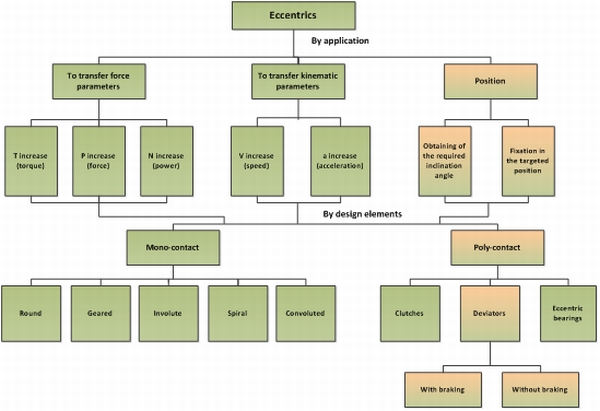
Further investigations of eccentric mechanisms demonstrated a great importance of the application in oil-and-gas industry, mechanical and aircraft engineering and other industries. The variety of approaches to the design, calculation theory, assessment of the technical condition and improvement of the existing designs of eccentric mechanisms (EM) requires their classification and further division into several principally different groups. The analysis demonstrated that based on the application EM can be split into three large groups (Fig. 1).
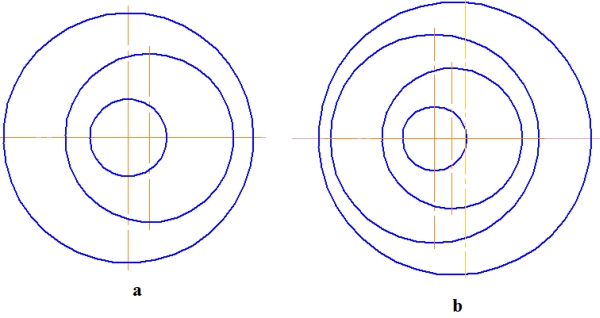
The eccentric mechanism can play the role of an eccentric stabilizer [8]; in this case it is applied to provide the required deviation angle of the drilling string and fixation of its elements in the targeted relative position. The provision of the required interconnected shifts in radial and angular directions is possible with the help of poly-contact eccentric deviators [3]. The necessary movement can be achieved with the help of two, three and more contour eccentric mechanisms (Fig. 2). However, in our opinion, a two-contour EМ is the simplest and the most reliable.
Consequently, the most perspective area is the development of designs with two-contour poly-contact eccentric mechanisms, including the ones with self-braking. In our case, the self-braking mechanism is the coupling with slight pressure and actuated by introducing the oil layer between the contact surfaces.
Analyzing the existing state of the theory of stressed-deformed state (SDS) calculation [9] of EM, we revealed that contact tasks are solved based on the analytical solution of Hertz problem [9] for two conjugated convoluted surfaces (Fig. 3) based on a number of assumptions:
- contact occurs under the conditions of dry friction with the friction coefficient k;
- dependence of the friction coefficient value upon the relative shifting speed of the contacting surfaces is ignored;
- linearization of boundary conditions;
- shifting of boundary conditions onto the non-deformed boundary surfaces;
- both conjugated convoluted surfaces are considered ideally even.
The existing scientific schools dealing with the calculation SDS and load capacity of eccentric mechanisms of B. L. Abramyan, V. M. Alexandrov, Yu. А. Amenadze et al., A. G. Gorshkov, E. I. Grigolyuk and D. V. Tarlakovsky proved the possibility of applying the numerical methods of mathematical modeling to calculate the load capacity of EM.
The characteristic feature of such tasks is the dependence upon the contact area time – mobility of boundary lines of edge condition types. The solution methods used in the tasks on stamps cannot be applied here, as a rule. The mathematical difficulties connected with dynamic contact tasks with mobile boundaries result in the necessity to develop specific approaches [5].
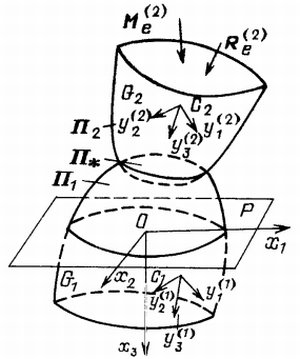
The analysis demonstrated that in the considered tasks on dynamic contact of bodies limited by convex surfaces, beside the ordinary issues on setting the contact type the problem of defining the contact area П* at each time moment is added. At the same time, it was found that the tasks with one-side contact are most widely used: contacting surfaces can sustain only compression stresses [5].
One of the vividly expressed examples of mathematical modeling to solve the conjugated mobile contact task is the task of impacting of two conjugated convoluted surfaces (Fig. 3).
In our case, several bodies are simultaneously contacting in the two-contour eccentric skewing mechanism (Fig. 4).
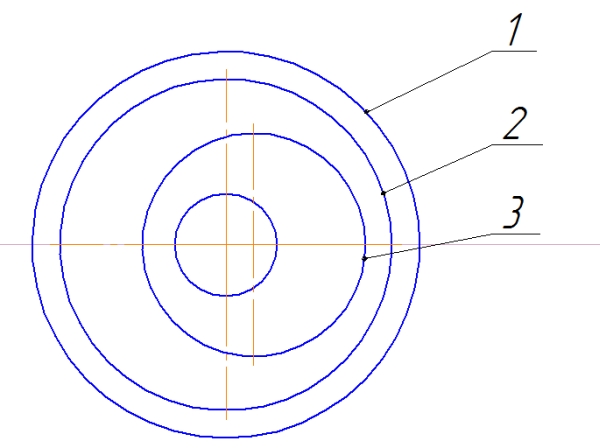
The external race 1 is contacting with the built-in eccentric 2 along the internal surface, and the internal eccentric 3, in turn, is contacting with the built-in eccentric 2 along the external surface. At the same time, the built-in eccentric 2 has a multi-contact with the two bodies – external race 1 along the external surface and internal eccentric 3 along the internal surface.
Therefore, the approach to solving the tasks on the contact of two conjugated convoluted surfaces proposed earlier cannot be applied in our case.
On the other hand, the fixed joints considered, including the poly-joints [2], demonstrated that the application of numerical methods is effective and provides good practical results.
In these works the fixed joints without clearance with the assumption of ideal geometry of bodies and lack of slippage conditions are considered.
In our case, the contact line is not in one plane. As the EМ parts convey the load with the help of mechanical transmission, which, in turn, can be of various types, it is necessary to calculate the transmission integrated into the EM and EM itself.
The modern theory of calculating EМ is a separate calculation of kinematic parameters, and a separate calculation of load capacity and SDS of each EМ.
Further investigations of two-contour EМ with self-braking demonstrated that the value of the load transmitted changes depending upon the type of eccentric used. It was also found that the type of mechanical movement transmission selected has a special influence upon the load value.
The analysis of modern EM calculating theories demonstrated that there is no theory of joint calculation of SDS, load capacity and kinetic parameters of EМ with self-braking.
Therefore the development of such theory requires the solution of the following tasks:
- to define the effective geometry of EМ with self-braking taking into account the integrated mechanical transmission;
- analysis of EM loading patterns;
- analysis of EM designs;
- finding the clearance between the EM elements;
- analysis of mechanical transmissions integrated into EM;
- analysis and recording of the contact interaction conditions.
The solution of all these tasks allows implementing the theory of calculating self-braking EM.
References
[1] Zhivov P. N. To the issue of completely automated control of the well drilling trajectory // Technologies. Equipment. Materials. – 2006. – Iss. 3. - P. 65–70.
[2] Kulish E. V. Stressed-deformed state and load capacity of press poly-joints: Abstract of PhD dissertation – Izhevsk, 2009. – 20 p.
[3] Lukyanov V. T. Development of the theory of well deviation control during drilling: Abstract of DSc dissertation: 05.15.10. – Krasnodar, 1998. – 45 p.
[4] Popov D. N., Panaiotti S. S., Ryabinin M. V. Hydromechanics: Student aid for HEIs / Ed. by Popov D.N. 2nd edition, stereotyped. – М.: Publishing House of N.E. Bauman Moscow State Technical University, 2002. – 384 p., illustrated.
[5] Shalashilin V. P., Gorshkov A. G., Troshin V. N. Strength of materials: Student aid. – Publishing House of Moscow Aviation Institute, 2000. – 616 p.
[6] Strength of materials with the basics of elasticity and plasticity theory / Vardanyan G. S., Andreev V. I., Atarov N. M., Gorshkov А. А. / Ed. by Vardanyan G. S. – М: Publishing House АСВ, 1995. – 568 p.
[7] Foldyna, V., Kübel, Z., Hlavatý, I., Beneš, L., Schmidová, E.: Problems of Build-up Austenitic Overlays on Carbon Steel Using APT Technology. In: Proc. of the 8th International Conference METAL´99, Ostrava 1999, pp.110, ISBN 80-85988-38-0
[8] Itskovich G. M., Minin L. S., Vinokurov A. I. Guide for solving the problems in strength of materials: Student aid for HEIs / Ed. by Minin L. S. – М.: Vysshaya shkola, 1999. – 592 p.
[9] Application No 2011120651/03 Controllable skewing mechanism / Chukhlantsev E. S., Shchenyatsky A. V. (RF) – 2011.
[10] Kulish E. V. Investigation of stressed-deformed state of press poly-joints with the solid and split bushing // Intellectual systems in manufacturing, 2(12), Izhevsk: Publishing House of ISTU, 2008. – p. 20-25. ISSN 1813-7911.
TEXT: A. V. Shchenyatsky, DSc, E. S. Chukhlantsev, PhD., Izhevsk State Technical University, Russia